On June 26, the Party Branch of the Party Committee & President's Office and the Party Branch of the Network and Information Center jointly held a themed Party Day event at the iHarbour under the theme "Establishing and Practicing a Correct View on Political Performance and Promoting the Integrated Development of Party Building and Professional Work." The event guided Party members and cadres in applying a correct view on political performance to their work practice, solidly advanced the deep integration of Party building and professional work, established a long-term communication mechanism, and strengthened mutual promotion and common improvement. The meeting was chaired by Zhang Wenxue, Secretary of the Party Branch of the Party Committee & President's Office, and attended by Party member representatives from both branches.
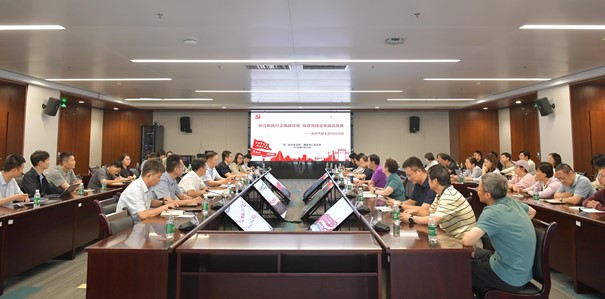
Collective learning was conducted at the meeting. Jiao Zhanyong, Deputy Secretary of the Party Branch of the Party Committee & President's Office, led the study of the guiding principles of the General Secretary Xi Jinping's important article "Advancing the Integrated Development of Education, Science and Technology, and Talent." Xu Mo, Deputy Director of the Network and Information Center, led the study of the guiding principles of the important instructions made by the General Secretary Xi Jinping on making constant efforts in east-west cooperation. Liu Jun, Deputy Director of the Network and Information Center, led the study of the guiding principles of the National Symposium on Party Building Work.
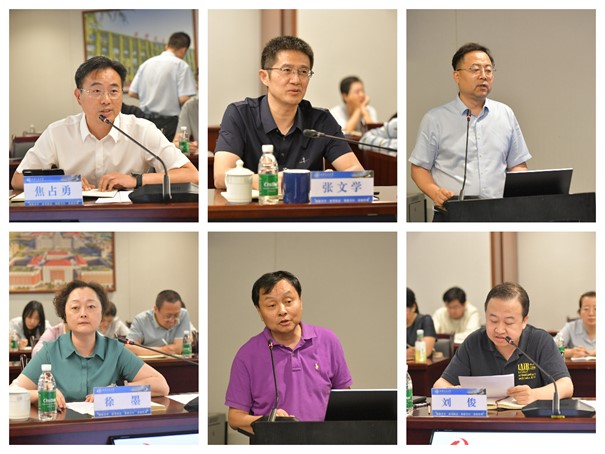
In the professional exchange and sharing session, Guo Hu, Director of the Policy and Regulation Office and Deputy Director of the Party Committee & President's Office, delivered a themed Party lecture closely focused on the development of the university's rules and regulations system. Starting from the macro perspective of institutional civilization and technological civilization jointly driving governance modernization, he elaborated in depth on the logical inevitability of rules and regulations serving as the infrastructure for running and managing an ultra-large-scale university, systematically reviewed the core functions of the university's rules and regulations in guiding behavioral norms, boosting development momentum, and resolving conflicts and risks, and explained the normative requirements for the hierarchy of effectiveness and formulation procedures of the university's rules and regulations.
Suo Zhihai, Secretary of the Party Branch of the Network and Information Center, delivered a themed Party lecture on the exploration and practice of dual integration and dual enhancement of Party building and professional work in light of actual work. He systematically introduced the practical pathway of the Party Branch of the Network and Information Center, which upholds the concept that "Party building is the soul, professional work is the flesh and blood," transforming political advantages into organizational advantages for technological breakthroughs. He highlighted the construction achievements of landmark outcomes, including the one-stop online service platform, electronic seals, the "Jiao Xiaozhi" AI agent platform, and Siyuan Academy, as well as the development plan for the 15th Five-Year Plan period to deepen the construction of computing power infrastructure, focus on innovative applications of artificial intelligence, and empower the digital transformation of the entire university.
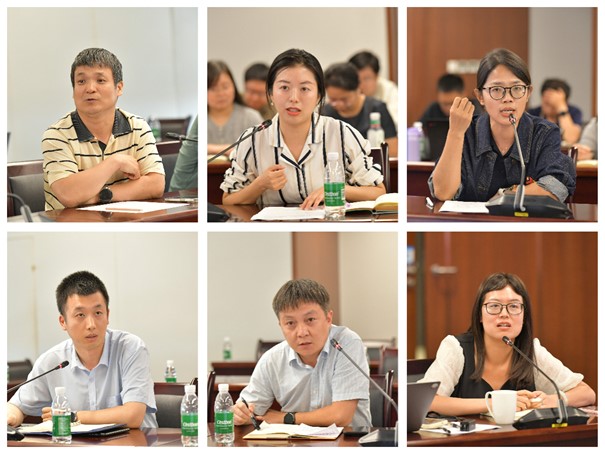
During the discussion session, the two sides conducted in-depth exchanges on topics including deepening paired co-building between Party branches, AI-empowered university governance, and the coordination between informatization development and internal institutional systems. Party member representatives, including Luo Junfeng, Dong Yang, Ren Wei, Liu Nan, Zhang Bo, and Chai Xiaoling, shared ideas and measures based on their respective positions. The participating Party members unanimously agreed that this cross-branch co-building event had established a platform for mutual learning and collaborative breakthroughs, breaking down professional barriers through Party building synergy. Going forward, they will continue to leverage the paired co-building mechanism, uphold Party building-led digital transformation, coordinate institutional improvement with the implementation of smart technologies, and tackle difficulties in informatization development through branch collaboration, thereby contributing to the enhancement of the university's governance capacity through the concrete results of deeply integrated Party building and professional work.
In his concluding remarks, Zhang Wenxue emphasized that under the guidance of a correct view on political performance, the effectiveness of Party building and professional work integration should be measured by the yardstick of "whether faculty and students find it useful and satisfactory." He expressed the hope that the two Party branches would continue to deepen cooperation in Party building co-development and technological collaboration, achieve mutual empowerment, and keep exploring cooperative pathways in areas such as business process optimization and the promotion and application of AI agents.
This joint themed Party Day event fully leveraged the bridging role of paired branch co-building, broke down barriers in professional exchanges, and achieved mutual learning and mutual promotion between Party building and professional work. The two sides will deepen co-building and collaboration on a regular basis, intensively promote the application of smart technologies and the dissemination of internal institutional norms, and build synergistic strength through Party building linkage, thereby enhancing both institutional management and digital service capabilities in a mutually reinforcing manner to better serve all faculty and students.