On the afternoon of March 27th, Xi'an Jiaotong University held the first public application demonstration training on the secure use of OpenClaw and OpenOcto at the Xingqing Campus, with nearly 500 teachers and students in attendance. The event was jointly organized by the Institute of Artificial Intelligence and Robotics, the National Key Laboratory of Human-Machine Hybrid Enhanced Intelligence, and the Network and Information Center. It aimed to popularize knowledge on the safe application of agent-based AI and showcase the first public application of OpenOcto, a domestically developed AI agent independently created by doctoral students at the university. The event was hosted by Suo Zhihai, Director of the Network and Information Center.
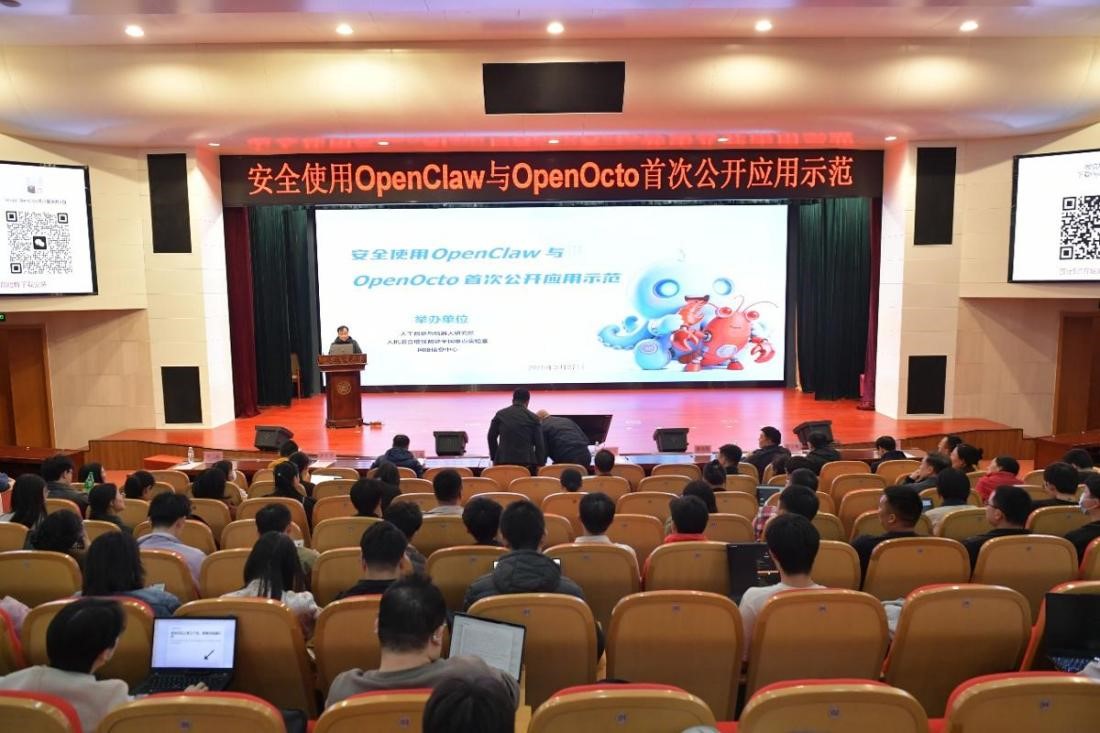
Recently, the open-source intelligent agent OpenClaw (commonly known as "Lobster") has garnered widespread social attention and sparked a wave of practical enthusiasm. However, its high-level permissions have raised concerns about risks such as data leaks and system control, prompting warnings from multiple national departments. This training aims to equip teachers and students with safe usage methods, addressing the challenges of "not knowing how to use it, using it poorly, or being afraid to use it."
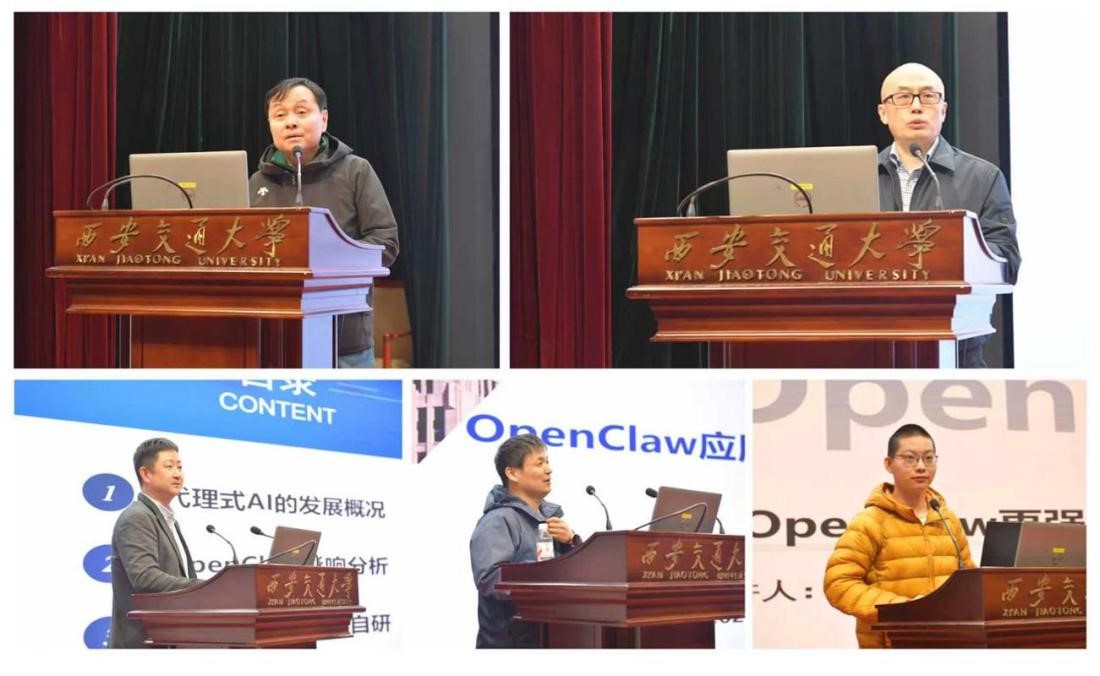
Suo Zhihai reviewed the school's exploration journey in the field of AI agents. He stated that from DeepSeek and "Jiaoxiaozhi" in 2025 to the open-source agent OpenClaw in 2026 , AI technology has been rapidly iterating. OpenClaw has played a significant role in scientific research and office automation, but it also presents security risks. He mentioned that the OpenOcto agent is adaptable to diverse scenarios, demonstrating the innovative spirit of Jiaotong University students in courageously confronting and surpassing international frontiers.
Lan Xuguang, the Party Committee Secretary of the Artificial Intelligence College, Chief Scientist of Embodied Intelligence at the National Key Laboratory of Human-Machine Hybrid Augmented Intelligence, and Professor at the Institute of Artificial Intelligence and Robotics, delivered a speech. He pointed out that Agent-based AI is a critical leap for artificial intelligence, transitioning from "knowing how to answer" to "capable of execution, planning, and collaboration." OpenOcto is dedicated to building a domestically developed AI labor infrastructure to achieve task comprehension, device operation, and collaborative work.
Professor Zhang Xuetao from the Institute of Artificial Intelligence and Robotics delivered a special report titled "From 'AI Empowerment' to 'Shaping a New AI World'—The Development and Application of Agent-based AI." He systematically outlined the developmental trajectory of Agent-based AI and, drawing on engineering practices such as manned spaceflight and lunar exploration projects, conducted an in-depth analysis of seven major security risks associated with OpenClaw, including exposure to public networks, sensitive data leakage, prompt injection attacks, and memory poisoning. He proposed potential preventive recommendations and emphasized the need for simultaneous advancement in both technological application and security governance.
Luo Junfeng, a researcher at the Network and Information Center, delivered a presentation titled "OpenClaw Application Guidelines and Security Boundaries," further sharing practical technical methods for safe usage, providing operable references for teachers and students to use OpenClaw securely. He stated that the school will guide teachers and students in using AI agents like OpenClaw safely in phases, build a campus foundational platform, stimulate a wave of AI applications, and advance AI empowering education.
This event unveiled the OpenOcto agent, which was developed by Gong Yiming, a graduate of the 2019 Youth Class and the 2021 Artificial Intelligence Elite Class, and a current doctoral student at the Institute of Artificial Intelligence and Robotics, under the guidance of Academician Zheng Nanning. Since its development began in May 2025, OpenOcto has now been iterated to version 4.0. OpenOcto can simulate human operations on computers and mobile devices, efficiently completing high-complexity, long-process tasks such as program development, data analysis, scientific research exploration, and administrative collaboration. It achieves full-chain domestic production and private deployment, with outstanding security, autonomy, and controllability, providing a safe and reliable solution for high-sensitivity scenarios such as universities and research institutions.
In the on-site experience session, hundreds of teachers and students enthusiastically participated, giving various instructions to OpenOcto and personally experiencing its performance. The teachers and students who attended the training expressed that the intelligent agent processes large-scale files quickly and efficiently, with a robust security and confidentiality mechanism. Compared to similar tools, it has significant advantages and greatly enhances learning and research efficiency.
This training marks another significant practice of the university in the application of AI technology and security governance. The university will continue to carry out a series of training on AI technology application, helping cutting-edge technology to serve teaching and research safely and efficiently, and promoting the innovation of domestic artificial intelligence and the intelligent transformation of higher education teaching.