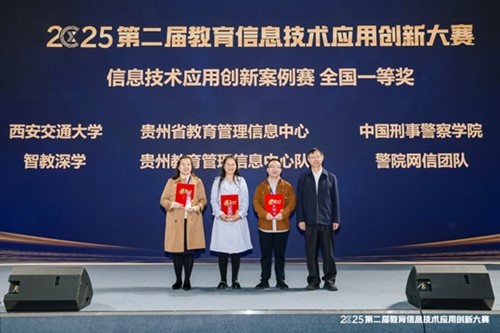
Recently, the 2025 Second Educational Information Technology Application Innovation Competition was held in Hangzhou. The event was organized by the China Association for Educational Technology, co-hosted by Zhejiang University and the Cybersecurity Professional Committee of the China Association for Educational Technology, and supported by the Information Technology Application Innovation Working Committee of the China Electronics Standardization Association and the Zhejiang University Alliance for Information Technology Application Innovation. Xi’an Jiaotong University’s case, "Intelligent Siyuan Academy—Innovative Practice of a Full-Scenario Teaching Platform with Information Innovation Chain Connectivity and AI Empowerment," won the national first prize. This marks the second consecutive year the university has secured the national first prize in this competition, showcasing its practical achievements and innovative capabilities in the field of information technology application innovation.
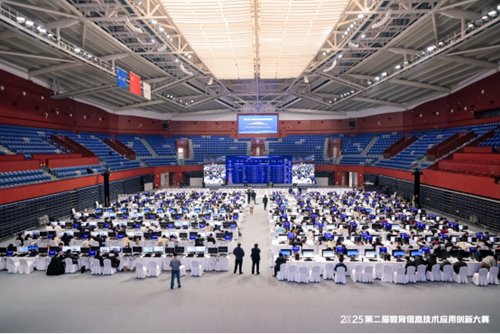
This competition precisely aligns with the actual demands of educational scenarios. By promoting learning through competition, it has effectively facilitated the deep integration of industry and education, providing a practical model for the development of a talent cultivation system in the information technology innovation industry. This year's competition attracted 6,198 teachers and students from 732 educational administrative units and universities across the country, forming a total of 2,474 participating teams. Compared to the inaugural competition last year, there has been a significant increase in both the number of participants and the scope of coverage. After multiple rounds of selection, 320 teams comprising 888 teachers and students from 295 universities nationwide advanced to the final round of competition.
The "Intelligent Siyuan Academy" is an intelligent undergraduate teaching platform jointly built by the Network and Information Center and the Academic Affairs Office. It focuses on the reform demand of entire teaching process empowered by artificial intelligence, marking the first time that AI teaching has been implemented across all disciplines, courses, and scenarios within the university. The platform offers AI-assisted functions such as lesson preparation, preview, quizzes, teaching assistance, study companions, subjective question grading, and video processing, covering all aspects of teaching—pre-class, in-class, post-class, as well as evaluation. It also provides interfaces for uploading teaching resources from other platforms and integrating intelligent agents, creating a comprehensive smart application that aggregates high-quality teaching resources and covers the entire chain of teaching, learning, management, and evaluation. This effectively supports talent cultivation in the AI era. In the autumn semester of 2025, over 4,700 courses have utilized the platform, with teachers creating more than 200,000 teaching activities. The total number of users has reached 28,000, with a daily average of 100,000 visits.
The university's Network and Information Center has integrated multiple technological approaches to establish a comprehensive foundational platform for the integration of the entire information innovation chain, covering everything from underlying servers to user terminals. Based on this platform, the center has implemented a full-chain information innovation transformation for the "Intelligent Siyuan Academy," ensuring the security and sovereignty of critical data such as teaching resources and classroom performance. This initiative fosters a self-reliant and controllable technological ecosystem and talent pool, thereby advancing the digital and intelligent transformation of education to adapt to future changes.
Next, Xi'an Jiaotong University will continue to deepen innovative practices in the field of information technology innovation, and in combination with actual business scenarios, gradually achieve the domestic replacement of servers, cloud platforms, operating systems, databases, and key business systems. This will enhance the level of independent control and security reliability, actively exploring new patterns in educational digitization.